
India’s climate diversity means a specification that works well in one region isn’t automatically the right default everywhere. Here’s a practical look at what actually shifts by region.
High-rainfall and monsoon-heavy regions
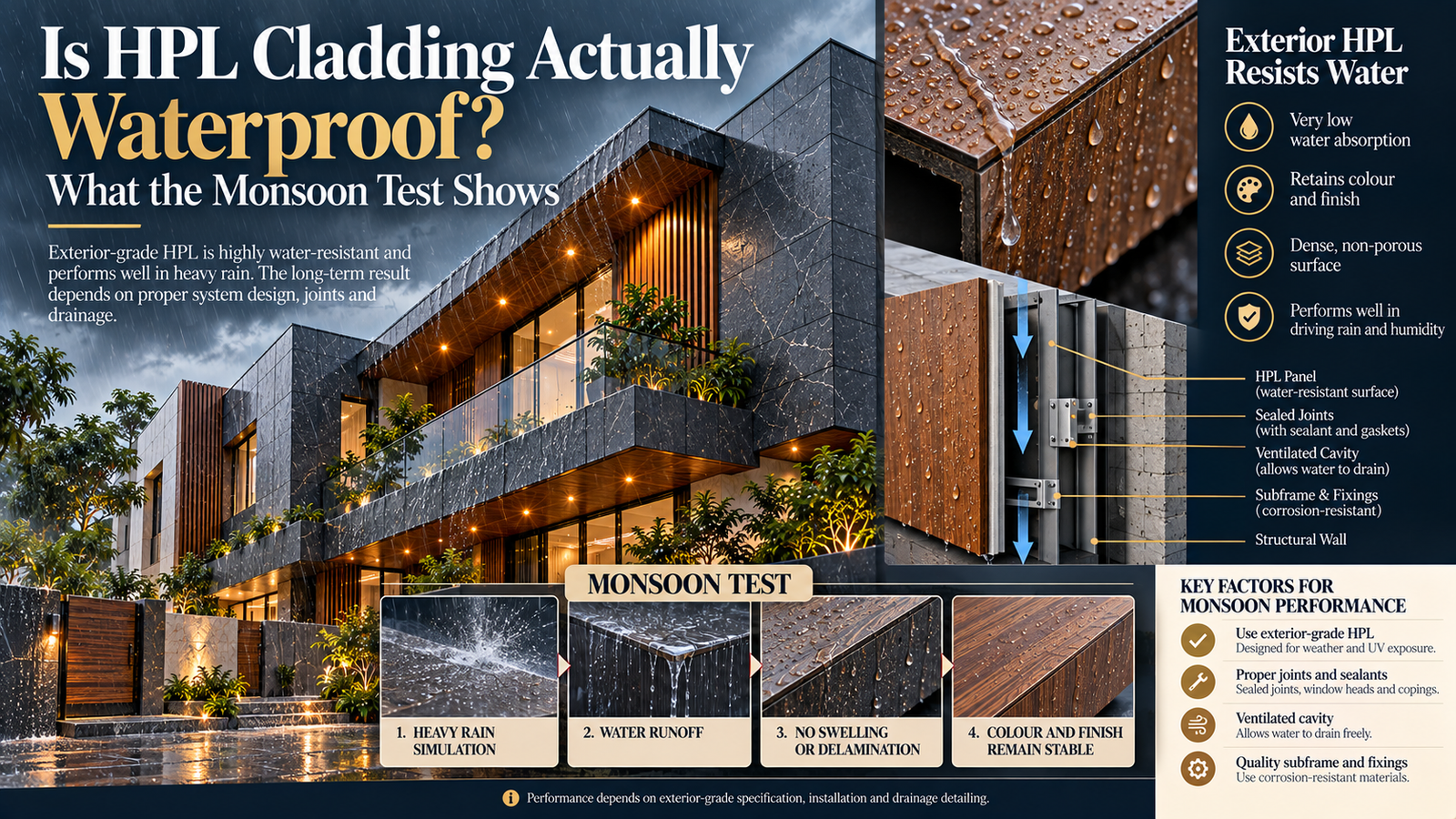
Coastal Karnataka, much of the Konkan coast, and parts of India’s northeast see sustained heavy rainfall for extended periods each year. Joint detailing and drainage behind the panel (the rain-screen air gap covered elsewhere on this site) matter more here than in drier regions, since the system needs to handle sustained, heavy moisture load reliably over many monsoon seasons.
Coastal and salt-air regions
Beyond rainfall, coastal areas add salt-air exposure to the picture, which mainly affects fixing hardware and substructure rather than the HPL panel itself — see our post on coastal and high-wind thickness considerations for the fixing-system implications specifically.
Hot, arid regions
Rajasthan, much of Gujarat, and inland central India see intense direct UV exposure and high surface temperatures, particularly on west-facing walls. UV-resistant colour formulation matters most here, and darker tones will run noticeably warmer to the touch than in a milder climate — worth factoring into colour choice for these regions specifically.
Northern regions with cold winters
Parts of north India see a wider seasonal temperature swing than most of the rest of the country. Panel thermal expansion and contraction (see our technical data sheet post for the relevant figures) is worth double-checking against local seasonal temperature range specifically, since joint gap specification should account for the actual expected swing, not a generic assumption.
High-altitude and hill regions
Additional considerations around wind exposure at altitude, and in some hill regions, occasional freeze conditions — both worth flagging specifically when specifying for these locations rather than assuming a plains-region default applies.
Why this matters for sourcing decisions
A manufacturer able to discuss region-specific specification — rather than quoting one generic product regardless of location — is generally the safer choice for any project outside a mild, average climate zone. This is exactly the kind of conversation HPLMaker’s technical team supports directly.
FAQ
Does HPLMaker offer different product variants for different climate zones, or is it one product specified differently?
Generally the latter — the same base compact HPL product, with thickness, fixing hardware grade, and joint detailing adjusted per project location and conditions.
Is there a simple way to know which considerations apply to my specific city?
Reach out with your project location directly — our technical team can flag the relevant regional considerations for that specific area.
Do colour recommendations change by climate zone?
Not as a hard rule, but darker tones on high-UV, high-heat west-facing walls in hot regions is a reasonable practical consideration worth discussing.